Category: Post

  • Separating the Wheat from the Chaff : Finding Quality in Wine

    Is there a difference in quality from one wine to another? Can you really tell the difference between a $100 and a $10 wine? What’s the difference between a mass-marketed wine and a small-production wine? These are the sorts of questions I get asked a lot.  Being able to find a quality wine is really the crux of my entire existence as a Sommelier and Wine Educator. It is also a central goal for many other Sommeliers and Wine Directors when creating their wine lists. With quality being our chief pursuit, what are the things that we look for in a wine? 

    One of the first things I look for is information, and I’m not talking about scores in wine publications. I’m talking about technical information. Have you ever tried to look up where some of the big box names get their grapes or how they make their products? I’ll save you the effort; they don’t publish it. Some might give some tasting notes, or even some nutritional info. But as far as specifics of the how, when, where, and what—forget about it. They don’t want you to know about all the chemical manipulations and other questionable practices used to make their product. In researching for this post, I read a “Supply Chain Transparency” statement on a popular box wine producer’s website, and frankly, it was alarming. Here is a snippet: 

    “As a policy, we do not knowingly employ slaves or trafficked persons, or knowingly tolerate  forced labor of any kind by our suppliers. We source the majority of our supplies from countries that have strict labor and employment laws that prohibit slavery and human trafficking.”

    I don’t know about you, but the fact that they need a statement saying they don’t knowingly employ slaves makes me wonder why such a statement would even be necessary, and whether they truly care about an ethical supply chain. And certainly I wonder about how they are treating their grapes if even the way they treat people is in question.

    On the other hand, if a winery tells you exactly where the grapes came from and what they did with them from start to finish, this is usually a good indicator that you are on the right track. Let’s explore Querciabella Chianti Classico as an example. They tell you the exact vineyards from which they harvested the grapes, with specifics about the soil composition and elevation of each location. They tell you how the grapes were harvested (by hand) and their viticulture practices in said vineyards. They tell you the exact type of aging and in what vessels, known as élevage (12 months in fine to extra fine-grained oak barriques (225 L) and tonneaux (500 L) of which 10% new – talk about specific!). They even tell you how many bottles they produce and the artist who created their label. 
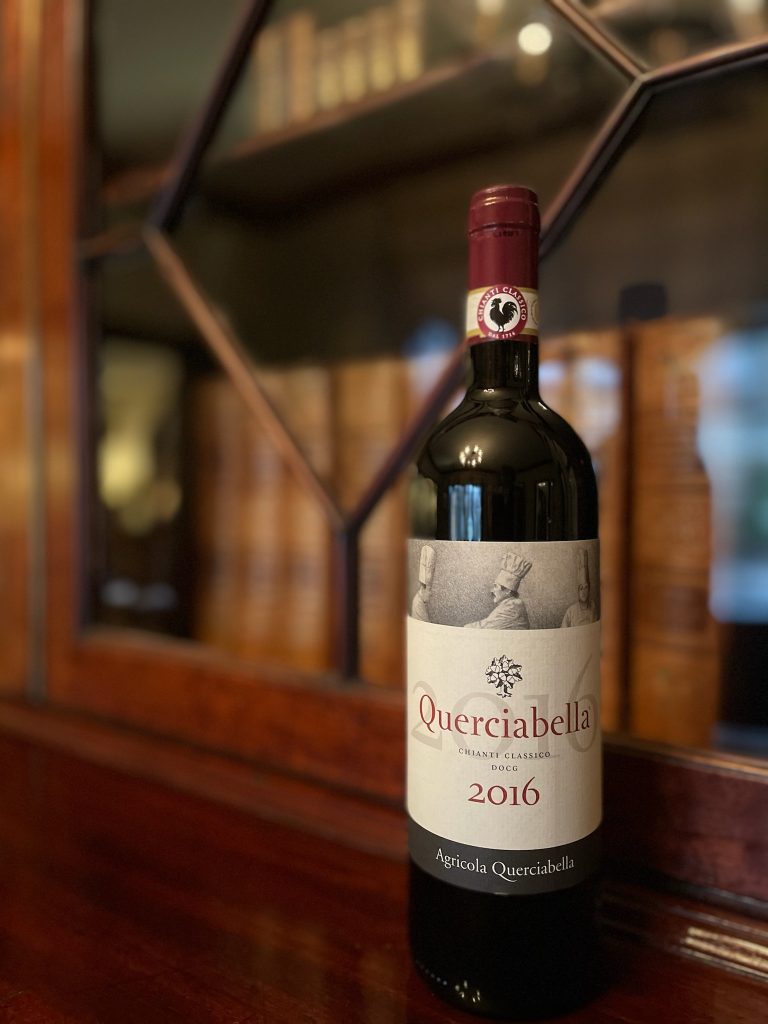
    I think the difference is clear. Now you might be thinking that the second wine probably costs a lot more money. Indeed Querciabella’s Chianti Classico will be more expensive than a box wine, but not as much as you might think given the detail of their technical information. Depending on your market, their Chianti Classico will cost you somewhere between $25-$30 for a 750 mL bottle compared to the $7-$15 for a 5 L of box wine. If you break that down into cost per 5 oz glass the Querciabella will cost you about $5 and the box wine will cost you $.44. For me the difference in the consumption experience is absolutely worth that extra bit of money!

    Finding detailed information on a wine is only a piece of the puzzle when hunting for quality. Of course the thing that completes the picture is the overall experience the wine gives the consumer–what the wine actually tastes like!  Sommeliers and Wine Directors will taste hundreds of wines in order to create wine lists that reflect quality. When tasting wines, we aren’t just drinking; we are evaluating the wines to determine whether we think it will bring the consumer the best experience! When comparing similar wines that all provide abundant technical information, it’s our job (and I hope will soon be your goal too!) to ascertain which ones have the “X-factor.” Some questions I am actively focusing on are: does the wine have complexity? Does it have any flaws (things like too much volatile acidity, overly oxidized, excessive Sulfur Dioxide, etc.)? Is the wine in balance? Does it transport my mind to the place it was made (also known as expressing terroir)? Does the wine demand my attention? Does it stop me in my tracks? A wine that meets my standards of quality is one with a symbiosis of flavors and excitement; it just has that something that keeps bringing me back to glass. It doesn’t have to be expensive, but it does need to be captivating! 

    When I find a wine that I know has been crafted with care and expertise and that also creates an experience in which I simply must take another sip, I know that I have succeeded!
  • Choosing Your Bubbles Wisely: An Introduction to Champagne Styles

    Just because New Year’s Eve is over doesn’t mean that we can’t still drink some tantalizing bubbles! As I will continue to say, you can drink Champagne whenever you feel like it! The fun thing about Champagne and other sparkling wine is that there is a style for every mood and occasion. Keep reading for a quick guide to choosing the right bottle based on sweetness level, grapes used, and winemaking style. All three play an important role in what the final Champagne will taste like.

    Champagne is one of the only regions in France that allows winemakers to add sugar into the wine after fermentation for the purpose of making it sweeter. One of the final stages of making Champagne is called Dosage, the addition of varying amounts of sugar syrup and wine. The winemaker decides how much sugar to add to the bottle to determine the final sweetness level of their wine. Most Champagne houses make several different wines with different dosage levels (measured in grams per liter).

    Here is the breakdown of what the label will say and what that means in terms of added sugar:

    LabellingDosage
    Brut Nature0-3 g/L, no added dosage
    Extra Brut0-6 g/L
    Brut0-12 g/L
    Extra Dry (or Extra Sec)12-17 g/L
    Dry (Sec)17-32 g/L
    Demi-Sec32-50 g/L
    Doux> 50 g/L

    Most people will begin to detect some amount of sweetness at around 8g/L (the upper end of the Brut level). It’s not exactly that simple, though, because detecting sweetness in a wine also depends on its acidity. A Champagne with lower acidity will taste sweeter than one with higher acidity, even if they have the same dosage levels. Two different Brut champagnes could express quite different levels of sweetness on the palate, but using this chart is a good starting point to help you select a bottle you’ll enjoy. If you know you enjoy sweeter wines but don’t want something that’s sweet enough to be dessert, you’ll want to hang out in the Extra Dry to Demi-Sec range. Brut Champagnes have been the most popular in recent years, and are probably what you’ll see the most of in your local wine shop.

    Besides the sweetness level, the label can also provide you with information on what grapes went into the bottle, which can give you more insight as to what your Champagne is going to taste like.

    Blanc de Blancs: Made from all white grapes (usually means 100% Chardonnay, though Pinot Blanc, Pinot Gris, Petit Meslier, and Arbane are also allowed) Champagne made from Chardonnay tends to be lighter, brighter, and a bit drier than ones made with the red grapes. I personally love starting my evening with a Blanc de Blancs; they make a perfect aperitif!

    Blanc de Noirs: Made from the red grapes (Pinot Noir and Pinot Meunier). These tend to have a bit more depth, and richness compared to Blanc de Blancs. Because of this, these are usually more enjoyable with savory foods.

    These few distinctions are broad generalizations based on the grapes, but what the winemaker does with those grapes will affect the final outcome of the wine just as greatly as the varieties. From here, things get a little harder to ascertain, because each Champagne House (Maison) has its own unique style that isn’t necessarily written on the label.

    Let’s a take a look at a few different Champagne producers, starting with the very well-known Veuve Clicquot. They specialize in Pinot Noir, and almost always use it as the dominant grape in their blend. Their most famous and most prolific bottling, known as their Yellow Label, uses 50-55% Pinot Noir, whereas their prestige cuvée (the best champagne of a house), La Grande Dame, has around 90%. In addition to highlighting Pinot Noir, Veuve Clicquot also chooses to use a 30-45% (the exact amount varies each year) of reserve wines into their blend. Reserve wines are base wines (wines that have not gone through a second fermentation in bottle) that are held back from a current vintage and aged longer. The higher percentage of reserve wine and the longer they have aged will deliver a wine that is deeper, more complex, and have more pronounced flavors of bread dough, mushroom, and bruised fruit.

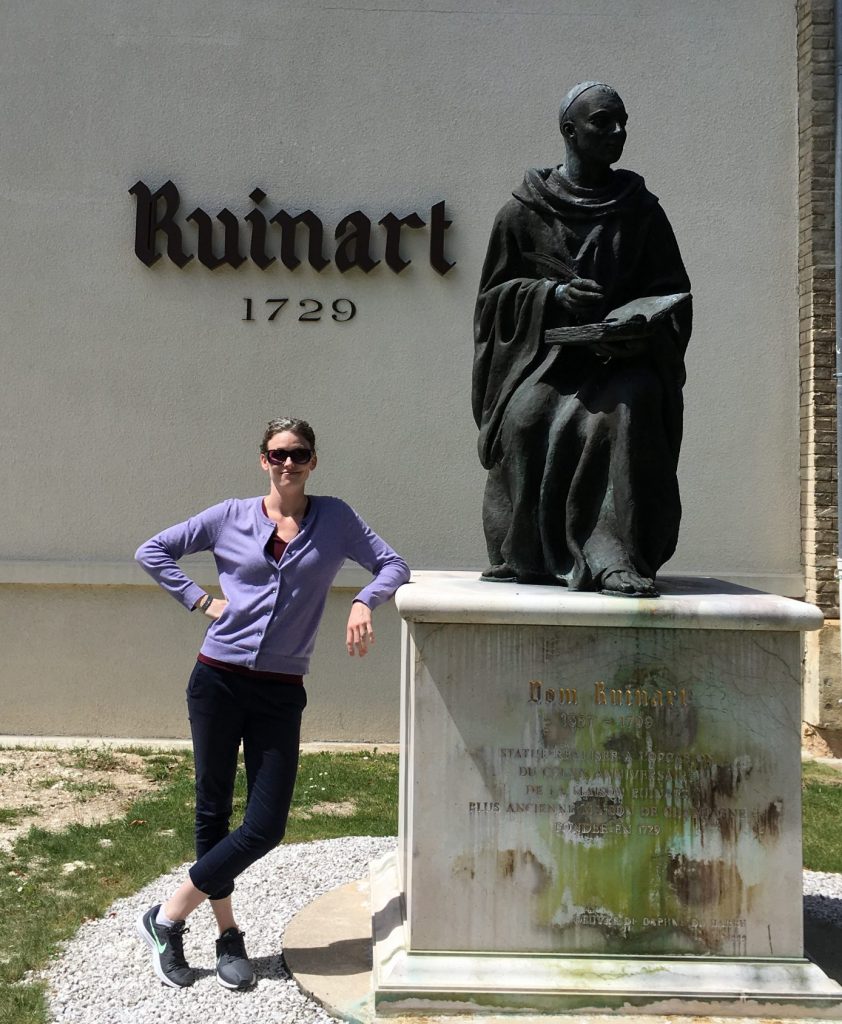
    Me at Ruinart

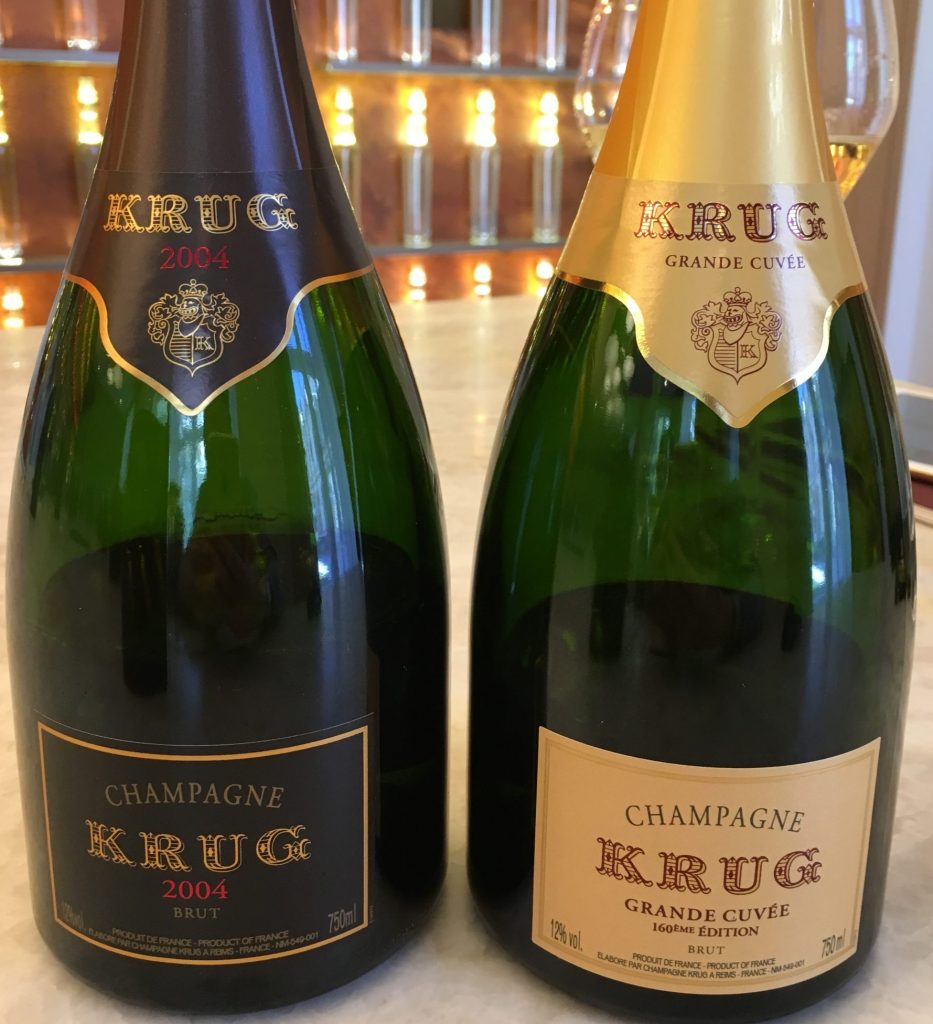
    Ruinart, another well-known house, uses Chardonnay as the “essence” of all their Cuvées. They make a Blanc de Blancs which is 100% Chardonnay but blend in about 20-25% reserve wines that are only 1-2 years old. They also choose to use stainless steel in all steps of the fermentation and aging process, so as to retain the freshness and elegance of the Chardonnay grape. This style of winemaking is referred to as reductive, and yields a brighter and more focused style of wine. The opposite winemaking style would be oxidative, which indicates the use of oak in their production. Krug is one well-known producer crafting oxidative wines, and this results in a vastly different finished product from Ruinart.

    Krug premier bottlings

    Finally, let’s learn about a house that highlights Pinot Meunier. Chardonnay and Pinot Noir are definitely the most famous grapes in Champagne production, but there are a handful of people doing some magical things with Pinot Meunier. Christophe Mignon is one such producer who is helping Pinot Meunier shed its underdog status. The ADN de Meunier bottle is 100% Pinot Meunier, and is fermented in stainless steel. Additionally this wine does not undergo malolactic fermentation, which is a different kind of fermentation that converts tart malic acid (think tart green apple) into soft lactic acid (think milk). It is also the cause of those buttery flavors you might be familiar with in California Chardonnay. Mignon chooses to block this type of fermentation, and therefore this wine will be quite tart and crisp.

    As you can see this small region has something for anyone and everyone’s taste. Here are just a few recommendations to get you started:

    Light and Bright:

    Ruinart, Blanc de Blancs, Brut, Non-Vintage: $60-$70

    Christophe Mignon, ADN de Meunier, Extra Brut Non-Vintage: $50-$60

    Pierre Peters, Blanc de Blancs, Grand Cru, Extra Brut: $80-$100

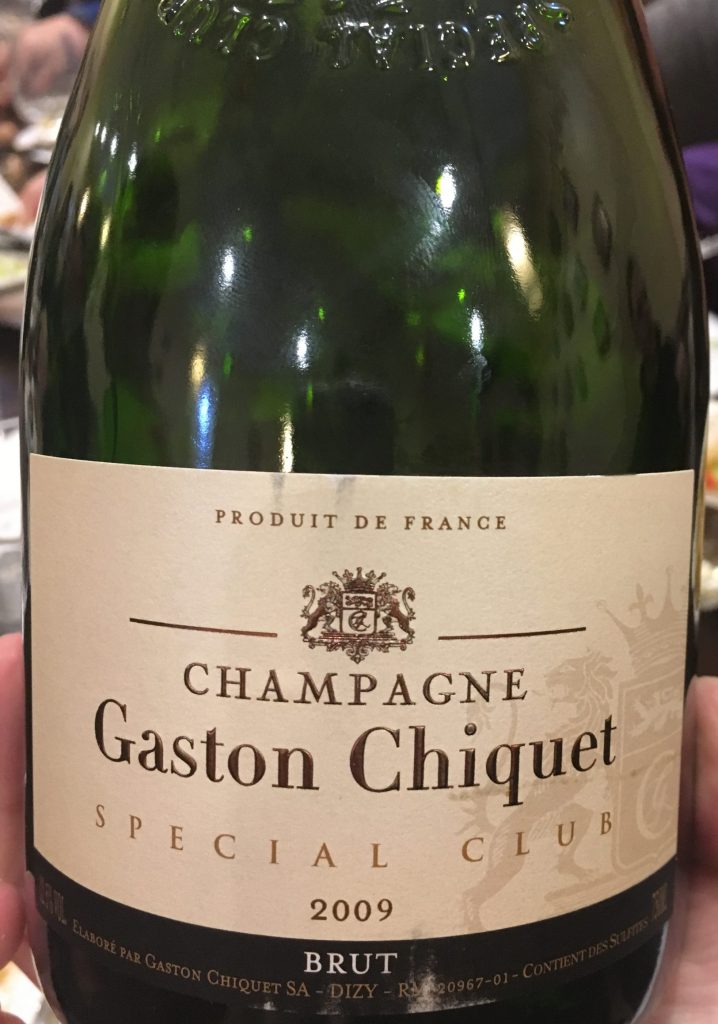
    Gaston Chiquet, Special Club, Grand Cru, Brut, 2009: $75-$80

    Medium and Well-Rounded:

    Veuve Clicquot, Yellow Label, Brut, Non-Vintage: $45-$55

    Louis Roederer, Brut Premier, Non-Vintage: $50- $60

    Pol Roger Brut Reserve Non-Vintage: $50-60

    Toasty and Rich:

    Duval-Leroy, Brut Reserve, Non-Vintage: $45-$55

    Bollinger, Brut, Special Cuvée, Non-Vintage: $50-$60

    Krug, Grande Cuvée, Non-Vintage: $150-$160

    Gaston Chiquet
    Gaston Chiquet, Special Club, Grand Cru, Brut, 2009

  • Monks, Kings, and Bubbles: An Absurdly Brief History of Champagne

    Champagne is one of those beverages that I will always say yes to, no matter the time or day. It’s also a convenient answer when people inevitably ask me what my favorite wine is. Of course that doesn’t begin to explain what my favorite style of champagne is, and I can never choose a specific producer, because there are just too many. But most of the time if I settle for answering with a broad region (and I’m not being pressed for further details by another wine-lover!) this seems to satisfy the question. 

    A lot of people save their champagne for celebrations like birthdays or New Year’s Eve (which is just around the corner!). But what some people may not realize is that this automatic association of popping a champagne cork in celebration didn’t just happen coincidentally. In fact, this connection between champagne and special occasions is the result of consistent and well-planned marketing efforts that started back in the late 1700s. 

    To get the full story, we first need to head back in time to understand some of the historical context of Champagne. One of the things that fascinates me about the wines and wine regions that are most well-known today, is that there is almost always a link to some significant event in history, along with some genius marketing, that made them so famous. Champagne is no exception.

    One commonly told, yet false, tale credits the invention of Champagne with the famous Monk, Dom Pérignon, in the 1600s. Though he was crucial in developing the blending part of the process, it was in fact, the Monks of St. Hilaire (located in a relatively unknown region called Limoux in the Languedoc, in southern France) who were the first creators of wines with effervescence. There is evidence that they were producing sparkling wines as early as the 1500s! That being said, up until the 1700s the creation of wine with bubbles was not well understood and only happened accidently. 

    At that time, the winemakers were trying to compete with the wines of Burgundy, and much to their dismay were baffled when they opened their wines to discover they had bubbles in them! We now understand how this happened: the winemaker would ferment their wine, the temperature would drop in the fall and would cause the yeast to fall asleep, stopping the fermentation. The winemaker, thinking the fermentation was complete, would bottle it and prepare it for storage. When the temperature would rise again in the spring, the yeast would reawaken and continue the fermentation. Since the wine was already bottled, the CO2 (given off during fermentation) had nowhere to escape, thus trapping bubbles in the bottle. On top of their dismay over unexpected (and at that time unwanted) bubbles, glass used for wine bottles in those days was not as strong as we have today, so those “flawed” bottles of sparkling wine would often spontaneously explode due to the pressure. 

    Simultaneous to this accidental discovery of exploding sparkling wine, the City of Reims was becoming politically important for France. Over a period of 600 years, 27 French Kings were crowned at the Cathedral Reims, and the local celebrations would have included the wines of Champagne. Besides wine, the region was known for its textile industry and had wealthy merchants traveling through consistently. These merchants would take the wines of Champagne back to their homes and helped spread word of these intriguing sparkling wines throughout France. There is also evidence of Champagne being shipped to Philadelphia and New York in the 1780s, and that even George Washington enjoyed imbibing it. 

    Champagne had started to gain a cultural momentum that not even the tumult of the French Revolution managed to stop, and demand continued to skyrocket. It was also in this era that the English aristocracy, Russian Czars, and the Kings of Belgium and Greece were becoming enamored with drinking it. Though the wines had been served at French coronations for centuries, it was during this time that the marketing campaigns came into full force. Provocative and tantalizing advertisements linked Champagne to luxury, and also to women, sports, and celebrations of all kinds. Champagne’s story doesn’t end there, of course, but the image of sparkling wine had been sealed during the Golden Age of the 1700-1800s. There is absolutely nothing wrong with popping a bottle of bubbly on your favorite holiday, but in 2020, I think everyone is in need of some extra cheer, so don’t be afraid to open a bottle on say, a Tuesday or any day you like! I promise you won’t regret it!

    Not sure about what style of Champagne you like? Stay tuned as my next article will help guide you through Champagne’s broad spectrum of styles.  

    Join my mailing list to be notified of new posts and upcoming events!

    Sources used: French Wine Scholar text – editorial staff Julian Camus and Lisa M. Airey, Champagne: The Essential Guide to the Wines, Producers, and Terroirs of the Iconic Region – Peter Liem